Fixing Red Skin Tones on Canon
Fixing Red Skin Tones on Canon
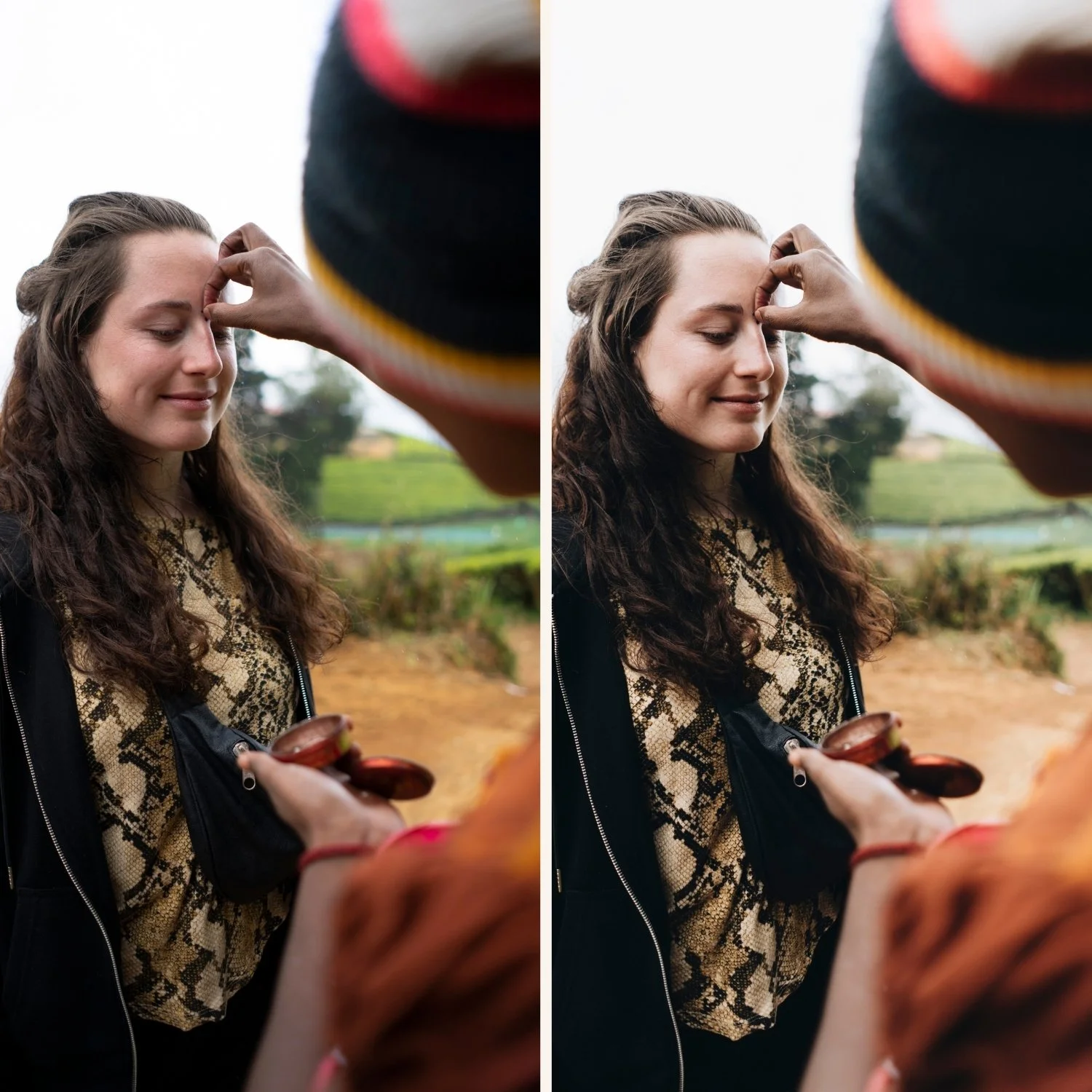
Canon photographers who apply a film preset and find their subjects looking sunburnt are running into a specific and entirely predictable interaction. Canon renders skin warmer than any competing system. A film preset adds warmth on top. Without preparation first, the two stack, and the result is red rather than golden.
This is not a fault in the camera or the preset. It is a preparation step most photographers skip, and it takes four adjustments, applied once as a saved Base preset, to fix permanently.
Why Canon Skin Turns Red
Canon's colour science has prioritised pleasing skin rendering for decades, and it carries a specific red warm bias in the RAW file, most visible in skin tones. Straight out of camera this reads as flattering. The problem appears the moment a warm film preset is layered on top of a Camera Calibration profile that is still set to Adobe Color, Lightroom's default. Adobe Color adds its own contrast and warmth to colour science that is already warm, and the combination is what pushes skin toward red rather than the golden quality the preset was designed to produce.
Understanding this sequence, rather than blaming the preset, is what actually fixes it.
The Canon Preparation Workflow
Apply these four adjustments before any film preset, in this order.
Camera Calibration: Camera Neutral. This is the single most important Canon adjustment and the one almost everyone skips. Camera Neutral flattens Canon's colour rendering to a less warm, less contrasty starting point, which is what a film preset needs to work correctly rather than stacking on top of an already warm foundation.
Red Hue: positive 8 to positive 10, toward orange. Found in the Color Mix panel, Hue tab. This is the adjustment that most directly resolves red skin, because it shifts Canon's characteristic red ruddy rendering toward a natural golden warmth rather than leaving it in the red range where a warm preset amplifies it further.
Red Saturation: negative 8 to negative 10. Reduces the intensity of the red channel specifically, which is where Canon's warm bias concentrates most heavily and where the sunburnt quality actually lives.
Highlights: negative 35 to negative 45. Canon files have good highlight latitude, but direct sun clips faster than that latitude suggests, particularly on skin.
Save these four together as a Canon Base preset. Apply it first, on every Canon file, before reaching for anything else. What was four manual adjustments becomes one click, applied consistently across a shoot.
Why This Fixes It When Temperature Does Not
The instinct when skin looks red is to cool the Temperature slider. This does not work, and understanding why prevents the frustration of trying it repeatedly with no result.
Temperature shifts the whole image cooler. The Red channel stays exactly as saturated as it was relative to everything else in the frame, so skin still reads red while the rest of the photograph goes cold along with it. The fix has to happen inside the Red channel specifically, through Hue and Saturation, not through a global white balance shift that affects the entire image equally.
Checking Whether the Fix Worked
Zoom to 100 percent on a cheek after applying the Canon Base preset and a film preset on top. You should see gradation between the brightest and darkest parts of the cheek, rather than a flat area of uniform red. A cheek that still reads as one flat red tone needs Red Saturation pushed slightly further, toward negative 12 to negative 15.
Check the ear and the side of the nose specifically. These are where red saturation clips first on most faces and they are the most reliable diagnostic areas.
Compare against a neutral surface in the same frame, a white shirt or a grey wall. If the neutral surface reads correctly while skin still reads warm or red, the issue is genuinely channel specific and the Red Hue and Saturation adjustment is the right tool. If the neutral surface also reads warm, the underlying white balance needs correcting as well, before the Canon Base preparation is applied.
When the Problem Is Worst
Warm indoor venue lighting compounds the effect. Tungsten and warm LED add ambient warmth before the file is even captured, so for indoor event and reception photographs, push Red Saturation to negative 12 to negative 15 as a starting point rather than the standard negative 8 to negative 10.
Golden hour outdoor light does the same. The correct response is not to cool the white balance, since that removes the golden quality you want to keep. Preserve the warm Temperature and let the Canon Base Red channel correction handle the excess on its own.
Subjects with naturally warm or flushed skin sometimes need an additional negative 3 to negative 5 in Red Saturation beyond the standard preparation. This is a per photograph adjustment rather than something to build into the Base preset itself, since applying it globally would leave cooler skin tones under corrected.
Presets That Work Well After This Preparation
Once the Canon Base preparation is applied, A6 Clean Portrait is the most broadly useful preset for Canon skin, since its calibration was built with this kind of warm starting point in mind. E6 Soft Heritage suits a softer, more faded portrait quality. G1 Clean Glow prioritises skin luminance specifically and performs well in golden hour and overcast light.
Best Lightroom Presets for Canon R Series covers the complete preparation workflow and the full preset range for current Canon R bodies. Best Lightroom Presets for Canon R6 and R5 covers the same preparation applied to the earlier R6 and R5 generation specifically, including where the two bodies genuinely differ.
FAQ
Why does reducing Temperature not fix red skin?
Temperature shifts the whole image cooler while the Red channel stays proportionally as saturated as it was. Skin still reads red while everything else in the frame goes cold. The correction needs to happen inside the Red channel specifically.
Does this happen on Canon JPEGs too?
Yes, and it is harder to correct there because the in camera Picture Style has already baked additional warmth and contrast into the file before you see it. Shooting RAW preserves the latitude needed to apply the Red channel correction properly.
Is Canon colour science worse than other systems for skin?
No. Canon's warmth is generally more flattering straight out of camera than more neutral systems. It simply requires the Camera Neutral and Red channel preparation before a warm preset is added on top, otherwise the two warm sources stack.
Try the Canon preparation workflow on your own files:
Download the free Analog preset and apply it after the Camera Neutral and Red channel correction described above, rather than on an unprepared file, to see the difference directly.
For a complete collection calibrated around Canon's warm colour science, the Studio Archive at $89 includes every preset referenced in this guide.