How to Adjust White Balance for Film Tones
How to Fix White Balance in Lightroom — Complete Guide (2026)
White balance is the most misunderstood setting in photography editing. Fix it correctly and every preset, every color adjustment, and every skin tone looks natural. Get it wrong and nothing works — not the preset, not the color grading, not the skin tones.
This guide covers exactly how to fix white balance in Lightroom for every common scenario — orange indoor photos, grey overcast skin, mixed lighting, and more.
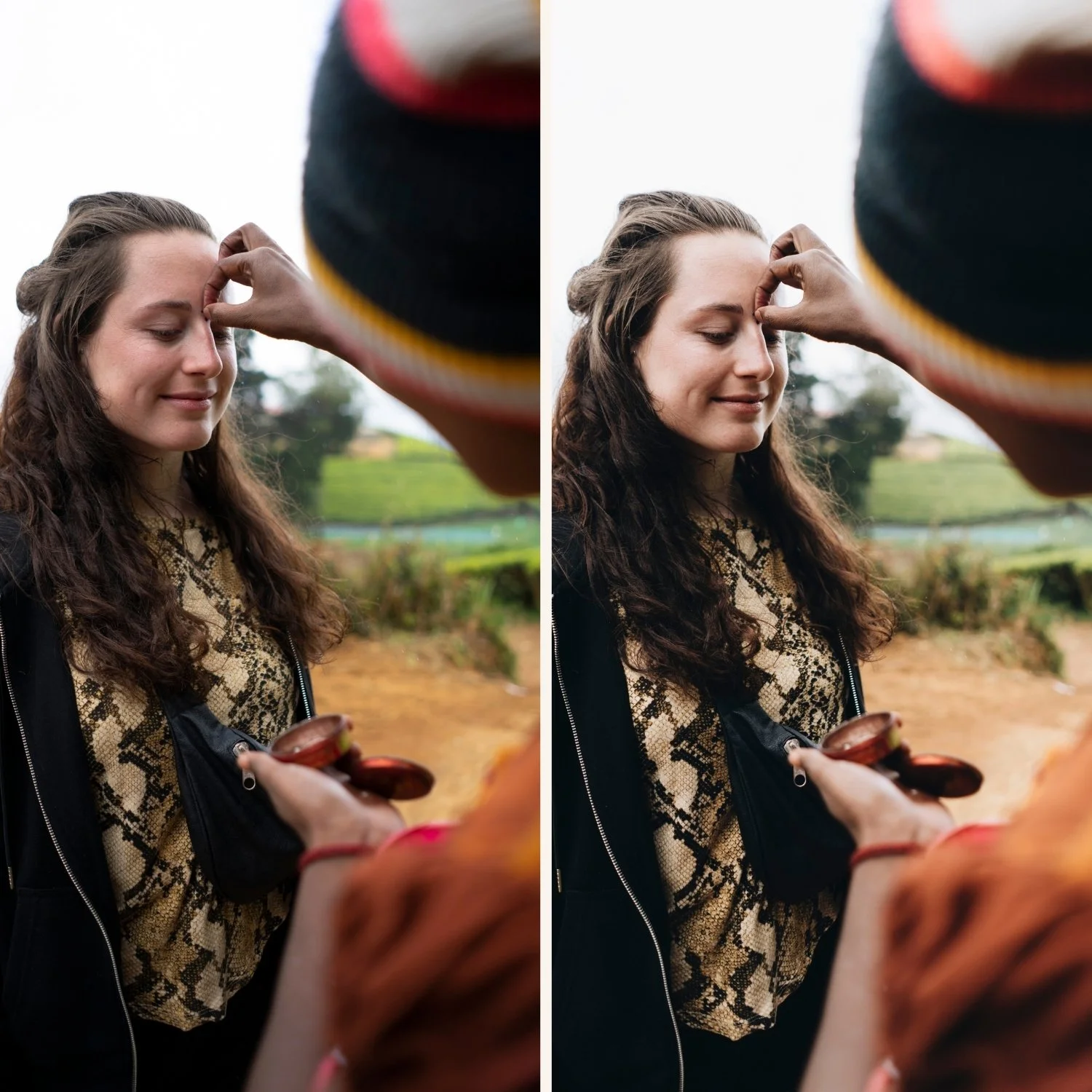
What white balance actually is
White balance corrects for the color temperature of your light source. Different light sources emit light at different color temperatures measured in Kelvin.
Candlelight: ~1,800K (very warm orange)
Tungsten/incandescent: ~2,700-3,000K (warm orange)
Indoor fluorescent: ~3,500-4,500K (neutral to slightly green)
Daylight: ~5,500-6,500K (neutral)
Overcast sky: ~6,500-7,500K (slightly cool blue)
Open shade: ~7,000-8,000K (cool blue)
When white balance is wrong, white objects look orange (too warm) or blue (too cool). Skin tones shift toward orange, pink, or grey depending on the direction of the error.
In Lightroom, the Temperature slider moves between warm (right) and cool (left). The Tint slider moves between green (left) and magenta/pink (right).
Method 1 — The eyedropper (most accurate for RAW)
The white balance eyedropper samples a neutral grey or white area in your photo and corrects the entire image to make that area neutral.
Step 1: Click the eyedropper tool in the White Balance section of the Basic panel.
Step 2: Find a neutral area in your photo — white wall, grey clothing, white ceiling. Avoid white areas that are in direct bright light (blown highlights).
Step 3: Click on the neutral area.
Lightroom adjusts Temperature and Tint automatically to make that area neutral white or grey.
When this works best: RAW files in consistent lighting with a clearly neutral reference point in the frame.
When this does not work: JPEG files (less accurate), images without neutral areas, mixed lighting where there is no single correct white balance.
Method 2 — Manual adjustment (most control)
Set Temperature and Tint manually based on what looks correct.
For orange/warm indoor photos:
Move Temperature to the left (cooler) — start with -400 to -800 from the default
Check skin tones — they should look natural pink-beige, not orange or grey
Adjust Tint if there is a green or pink cast
For blue/cool outdoor photos:
Move Temperature to the right (warmer) — start with +200 to +400
Reduce if skin starts looking orange
For green fluorescent cast:
Move Tint to the right (toward magenta) — start with +10 to +20
For pink/magenta cast:
Move Tint to the left (toward green) — start with -5 to -15
Method 3 — Preset white balance values (fastest for known conditions)
If you shoot consistently in the same environments, use preset white balance values:
Outdoor daylight: 5500K, Tint 0
Outdoor overcast: 6200K, Tint +5
Indoor tungsten: 3200K, Tint +10
Indoor LED: 4500K, Tint +5
Window light (indoor): 5000K, Tint +5
Golden hour: 6000K, Tint +8
These values are starting points. Fine-tune to match your specific camera and environment.
Why white balance must be fixed before applying presets
This is the most important workflow principle for preset users.
Applying a film preset to a photo with wrong white balance stacks two color problems on top of each other. An orange indoor photo with a warm preset applied becomes very orange. A cool outdoor photo with a warm preset applied looks closer to neutral — but not for the right reason.
The correct order:
Set correct white balance first
Apply preset
Fine-tune
Fix the foundation before adding style. This principle is why some photographers get great results from presets and others get inconsistent results — the ones getting great results fix white balance first.
Common white balance problems and fixes
Orange skin in indoor photos Cause: tungsten or warm LED lighting with Auto WB or incorrect manual WB. Fix: cool Temperature to -600 to -1,000 from default indoor values. Check that a white wall reads as white after correction.
Grey, flat skin in overcast outdoor photos Cause: overcast sky creates cool, flat light that desaturates warm skin tones. Fix: warm Temperature +200 to +400. This adds the warmth that the flat light lacks.
Green cast in office or fluorescent lighting Cause: fluorescent lights emit a green spike that cameras struggle to correct automatically. Fix: move Tint to the right (+10 to +25) to add magenta and neutralise the green.
Inconsistent skin tones across a gallery Cause: different photos were shot in slightly different lighting and have different white balance starting points. Fix: use the eyedropper on a neutral area in each photo individually. Do not batch-apply white balance unless all photos were shot in identical lighting.
Preset looks different on every photo This is almost always caused by inconsistent white balance rather than a bad preset. Fix white balance before applying presets and the results become consistent.
Full guide: Why Do Presets Look Different on Every Photo?
White balance on Lightroom Mobile
The white balance controls on Lightroom Mobile are in the Color panel — Temperature and Tint sliders work identically to desktop.
The eyedropper is also available — tap the eyedropper icon in the Color panel and tap a neutral area in your photo.
For iPhone photos specifically: Apple's computational photography processing sometimes creates unusual color casts that the standard corrections above do not fully address. Shooting ProRAW gives you more white balance latitude.
Free preset after white balance correction
Once your white balance is correctly set, apply the free A6 preset to add the analog film look. With correct white balance as the foundation, the preset should look accurate immediately with only minor exposure fine-tuning needed.
FAQ
What is the correct white balance for portraits?
For outdoor daylight portraits: 5500K, Tint 0 to +5. For window light portraits: 5000K, Tint +5. For indoor tungsten: 3000-3200K, Tint +10. Fine-tune so that white areas in the frame look genuinely white.
Should I fix white balance before or after applying a preset?
Always before. White balance is the foundation. Fix it first, then apply the preset.
Why does my white balance look right on my camera but wrong in Lightroom?
Lightroom ignores in-camera white balance for RAW files and applies its own default. Your camera's white balance only applies to JPEG files. For RAW, always set white balance in Lightroom.
Can I fix white balance on a JPEG in Lightroom?
Yes but with less accuracy than RAW. JPEG files have less latitude for white balance correction — significant corrections will show color banding or quality loss. Shoot RAW if white balance accuracy matters.