Why Your Photos Look Flat and Digital (And How to Fix It in Lightroom)
Why Your Photos Look Flat and Digital (And How to Fix It in Lightroom)
You open your image. You adjust exposure. You add contrast. Maybe increase Vibrance.
And somehow it still looks flat.
Clean. But lifeless. Digital, not cinematic. Processed, not timeless.
If this keeps happening, it is almost never your camera. It is almost always one of five predictable editing mistakes. This guide explains each one and how to fix it.
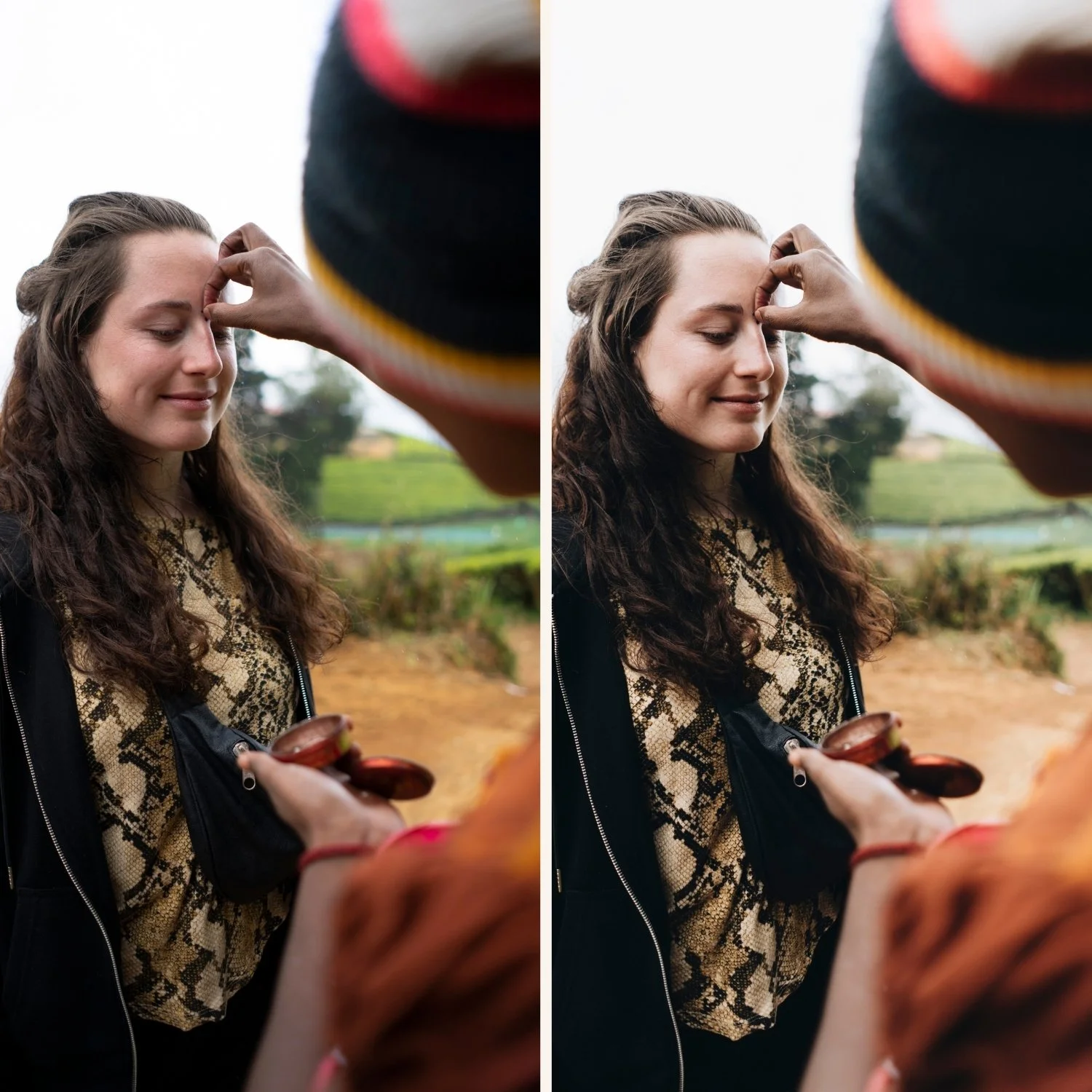
Why Digital Photos Look Flat Even After Editing
Digital cameras produce files with a certain linearity that human vision does not experience. The way a sensor captures a midtone is technically accurate but visually flat. Film introduced non-linearities at every tonal range, particularly in how it compressed highlights and separated shadows. These characteristics are what most people perceive as "depth" in a photo.
Fixing flat digital images means recreating those characteristics deliberately in Lightroom, not just pushing contrast up.
Problem 1: Your Highlights Are Too Harsh
When whites hit pure white, detail disappears and a hard edge appears at the boundary between bright tones and clipped zones. That edge instantly reads as digital.
Fix:
Lower Highlights slightly (-20 to -40)
Lower Whites slightly (-5 to -15)
Pull down the top-right point on the Tone Curve
Add a subtle bend just below to create a smooth roll-off
The goal is not to darken the image. It is to prevent the hard tonal jump at the bright end.
Problem 2: Your Blacks Are Either Crushed or Lifted Too Much
Flat photos are often a shadow problem as much as a highlight problem.
Two common extremes:
Crushed blacks: everything looks heavy and muddy, detail is lost in shadows. Lifted blacks: everything looks washed out and matte, the image has no grounding.
Film depth comes from controlled shadow layering. Shadows should retain texture and separation, not disappear into black or float above it.
Fix:
Adjust the Blacks slider carefully rather than dramatically
Avoid extreme matte lift curves unless you are targeting that specific look
Add contrast through the Tone Curve rather than the global Contrast slider
Zoom in and check that shadow areas still contain visible texture
Flatness very often lives in the shadows, not the midtones.
Problem 3: Clarity and Texture Are Doing Too Much Work
Clarity creates micro-contrast, which makes images feel more dramatic and detailed. But too much of it hardens skin, creates sharp edges around textures, and adds a digital quality that removes natural softness.
When an edit feels flat, the instinct is to add more Clarity. This usually makes the problem worse.
Fix:
Reduce Clarity slightly, especially on portraits and soft-light images
Reduce Texture slightly
Let tonal depth come from the Tone Curve, not edge contrast
Problem 4: Saturation Is Doing the Heavy Lifting
If your edit depends on Vibrance or Saturation to feel interesting, it will feel digital. Film tones are slightly restrained, balanced, and controlled. Pushing saturation adds color energy but not depth.
Fix:
Reduce Vibrance slightly on most images
Adjust individual color channels in HSL instead of global Saturation
Avoid pushing neon greens or oversaturated oranges
If color still feels artificial after this, check whether White Balance is compensating for a base issue.
Problem 5: No Tonal Hierarchy Between Foreground, Subject, and Background
Flat images often lack separation between tonal planes. Everything sits at the same contrast level. The eye has nothing to travel through.
Film depth usually comes from three distinct zones: controlled highlights in the bright areas, a balanced midtone range where the subject lives, and subtle shadow separation in the background.
Fix:
Adjust Exposure first to set the midtone anchor
Then adjust Contrast
Then refine with the Tone Curve
Then adjust HSL
Add subtle grain last
Order matters. Grain added before tonal structure is just noise.
| Check | Adjustment |
|---|---|
| Highlights clipping? | Lower Highlights and Whites. Soften with Tone Curve. |
| Shadows crushed or lifted too far? | Adjust Blacks carefully. Check shadow texture at 100%. |
| Clarity too high? | Reduce to -5 to +5 range. Let tone carry depth. |
| Saturation masking flatness? | Reduce Vibrance. Use HSL channels instead. |
| No separation between tonal planes? | Rebuild with Exposure, Curve, and HSL in that order. |
Do not add more sliders when an image feels flat. Refine what is already there.
What Actually Creates Depth in a Photo
Depth does not come from extreme contrast, heavy saturation, or hard sharpening. Depth comes from tonal control: soft highlight roll-off, precise shadow separation, restrained color, and a clear hierarchy between tonal planes. Flatness is almost always caused by excess, not by lack.
The Analog Series
If you are constantly rebuilding depth from scratch on every image, the issue is often the starting point, not your technique. A calibrated tonal base with soft highlights and layered shadows eliminates most of the flatness problem before you touch a single slider. The Analog Series was built around balanced contrast, soft highlight behavior, and controlled shadow layering so that depth is built into the base, not added after the fact. Explore the Analog Series
FAQ
Why do my photos look flat after exporting?
Check export sharpening settings and JPEG compression level. Also confirm that highlights are not being clipped during export, which can remove the tonal subtlety that made the edit look good in Lightroom.
Why does a preset look good on one photo but flat on another?
Lighting differences. A preset built for soft golden hour light will flatten under harsh midday sun. The base needs to match the light quality, or you need to adjust Exposure, Highlights, and White Balance for each lighting condition.
Is a flat photo always a bad result?
Minimalism is different from flatness. A deliberately minimal edit can be quiet and elegant. A flat image lacks tonal separation and visual depth. The distinction is whether the lack of contrast is a choice or an accident.
Can I fix a flat RAW file that was underexposed?
Partially. Lifting an underexposed RAW will introduce noise and reduce tonal range in the shadows. It is better than nothing, but the correct exposure in-camera will always produce more depth and detail than recovery in post.