Lightroom Mobile vs VSCO-Style Filters — Complete Comparison (2026)
Lightroom Mobile vs VSCO-Style Filters — Complete Comparison (2026)
Lightroom Mobile and VSCO-style filter apps are both used for film look photography on mobile. The question photographers ask most is which produces better results — and whether the difference is significant enough to change tools. The honest answer is: for precision film quality, portrait work, and consistency across a body of work, Lightroom Mobile is significantly better. For quick, casual content in good light, filter apps produce results that are good enough.
What VSCO-style filter apps do
VSCO, Afterlight, Huji, A Color Story, and similar apps apply a colour transformation to the phone's processed JPEG output — after Apple's or Samsung's computational photography pipeline has already run. The filter changes colour, contrast, and tone. The controls beneath the filter are limited: brightness, contrast, saturation, fade, and sometimes a few more.
The experience is optimised for speed: browse thumbnails, tap a filter, share. This is a genuine advantage for photographers who want a consistent casual look on daily content without learning editing tools.
What these apps cannot do: individual colour channel control (no per-channel Hue, Saturation, or Luminance), Shadow Color Grading with Blending control, three-parameter grain calibration, Camera Calibration profile changes, or RAW file editing with full sensor latitude.
What Lightroom Mobile does differently
Lightroom Mobile with a DNG preset applies the complete film look workflow to RAW or JPEG files with access to the full editing engine. This includes:
Camera Calibration profile. Changes how the RAW data is fundamentally interpreted — Camera Standard for Sony, Camera Neutral for Canon, matching simulation for Fujifilm. Filter apps apply to the phone's output with no access to this layer.
HSL per channel. Individual Green Hue +10 toward yellow, Orange Luminance +14 to +18, Blue Saturation -12 to -16. Each colour can be shifted independently. Filter apps have no equivalent.
Color Grading with Blending control. The warm amber Shadow Color Grading (Hue 35-42, Saturation 10-16, Blending 45-55) that creates dimensional film shadow quality. Filter apps can add global warmth — they cannot target the shadow range specifically.
Three-parameter grain. Amount, Size, and Roughness. Roughness above 44 creates the organic randomness of real film grain. Filter apps typically have a single grain slider producing a more uniform texture.
RAW file editing. Lightroom Mobile processes ProRAW (iPhone 12 Pro+) and Expert RAW (Samsung) with full editing latitude. Highlight recovery, shadow lifting, and non-destructive white balance recalculation from sensor data. Filter apps work on the JPEG output.
Where the quality difference is visible
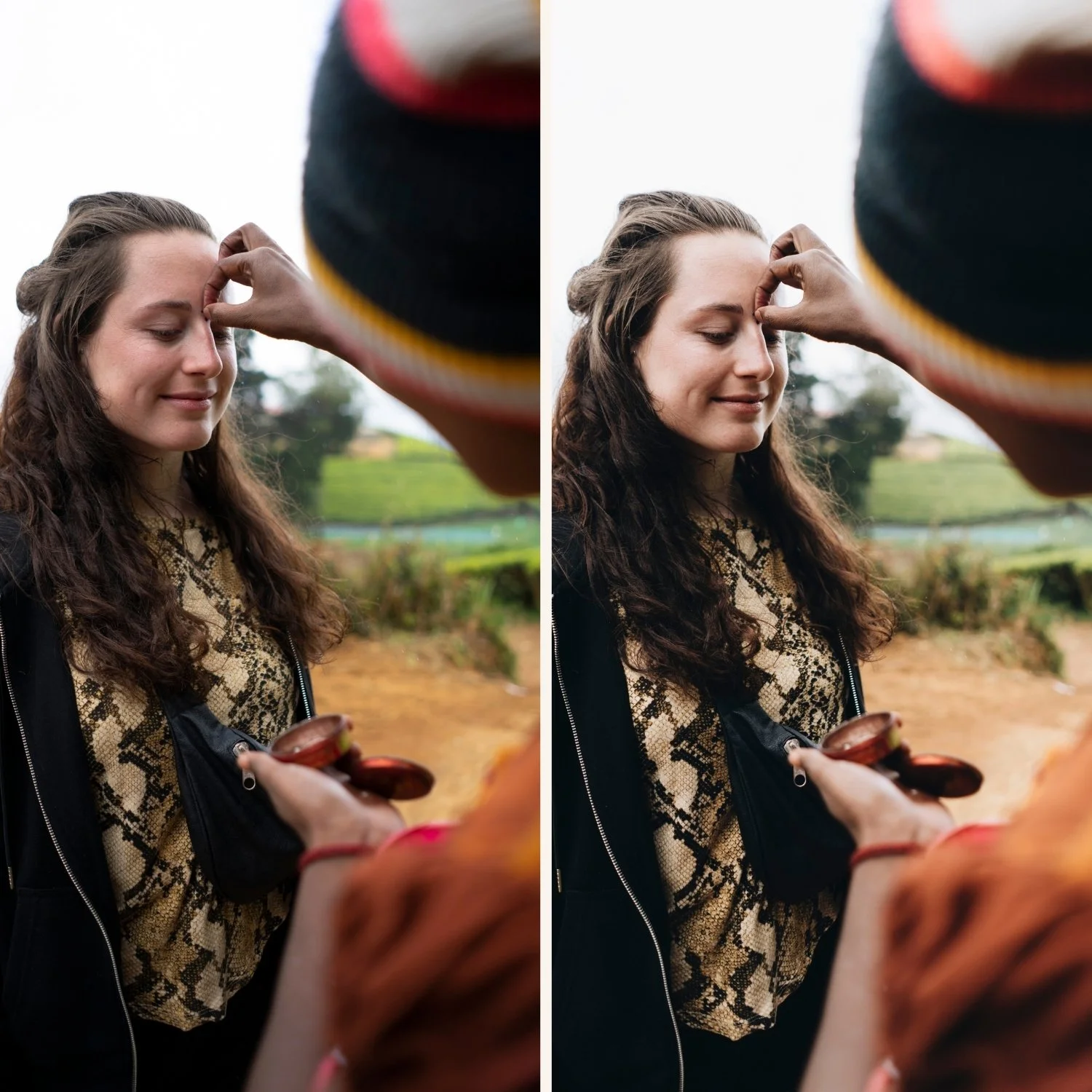
Skin tones. The Orange Luminance lift and Orange Hue shift in a Lightroom preset produce luminous, golden skin that filter apps cannot match with their limited colour controls. On a portrait in outdoor light, this difference is clearly visible.
Shadow depth. The Shadow Color Grading in Lightroom presets creates warm, dimensional shadow quality. Filter apps add fade or warmth globally — they cannot create the specific amber shadow depth that makes film photography feel dimensional.
Highlight recovery. On ProRAW files, pulling Highlights -45 in Lightroom recovers actual highlight detail from sensor data. On JPEG, the same slider reduces brightness on areas that may already be clipped from the phone's processing.
Grain quality. Lightroom's calibrated grain with Roughness 44-52 looks organic and photographic. Filter app grain often reads as a texture effect at close inspection.
Consistency. Lightroom's preset-based workflow is more consistent across varied lighting because white balance and exposure are corrected per photo within the consistent preset framework. The same filter applied to an overcast photo and a golden hour photo produces very different results because the filter cannot know the starting white balance.
The cost comparison
Lightroom Mobile is completely free. All TES DNG presets install and work free in Lightroom Mobile. There is no cost argument for choosing filter apps over Lightroom Mobile — the better tool is available at the same price.
The argument for filter apps is workflow speed: one tap from the camera roll, no app-switching. Lightroom Mobile with a preset applied is not significantly slower for individual photos, but requires opening a different app.
When to use each
Use Lightroom Mobile with DNG presets when skin tones matter, when you are editing ProRAW files, when you want consistent results across a body of work, or when print quality is a consideration.
Use VSCO or filter apps for casual daily content in good light where a film-inspired look is sufficient and speed is the priority.
These are not mutually exclusive. Many photographers use filter apps for quick stories and casual posts while using Lightroom Mobile for photos they care about.
The Analog Film Archive on Lightroom Mobile
All TES presets install and work free in Lightroom Mobile. The A6 Clean Portrait preset is available as a free download to compare directly against filter app results.
FAQ
Can I import TES presets into VSCO?
No. VSCO uses its own filter format. DNG presets are Lightroom-specific — they only work in Lightroom Mobile or Desktop.
Does VSCO support RAW files?
VSCO has limited RAW support but the editing precision is significantly less than Lightroom Mobile. For full RAW editing with film preset quality: use Lightroom Mobile.
What is the best free alternative to VSCO for film look editing?
Lightroom Mobile free. More capable than VSCO for the film look, free to use, and supports quality DNG presets that filter apps do not.
Can I use filter apps on photos I already edited in Lightroom?
You can export from Lightroom and then apply a filter — but this double-processes the image. A filter on a Lightroom-edited JPEG adds another colour transformation on top of the preset's calibrated result. Generally, apply the preset in Lightroom and export without additional filtering.
Related guides
FAQ
Can I get results as good as desktop Lightroom on Lightroom Mobile?
Yes for most photography. The editing tools are identical. The difference is workflow efficiency — desktop is faster for large batches. For individual photos, mobile quality matches desktop quality.
Does VSCO support RAW files?
VSCO has limited RAW support on some devices. The editing precision on RAW in VSCO is significantly less than in Lightroom Mobile.