Matching Fujifilm JPEGs with RAW Edits in Lightroom (2026)
Matching Fujifilm JPEGs with RAW Edits in Lightroom (2026)
Fujifilm JPEGs look stunning straight from camera. Fujifilm RAW files in Lightroom look flat and grey. The goal of this guide is to make your RAW edits look like your JPEGs — while retaining the full editing latitude that RAW provides.
Why RAW and JPEG look different on Fuji
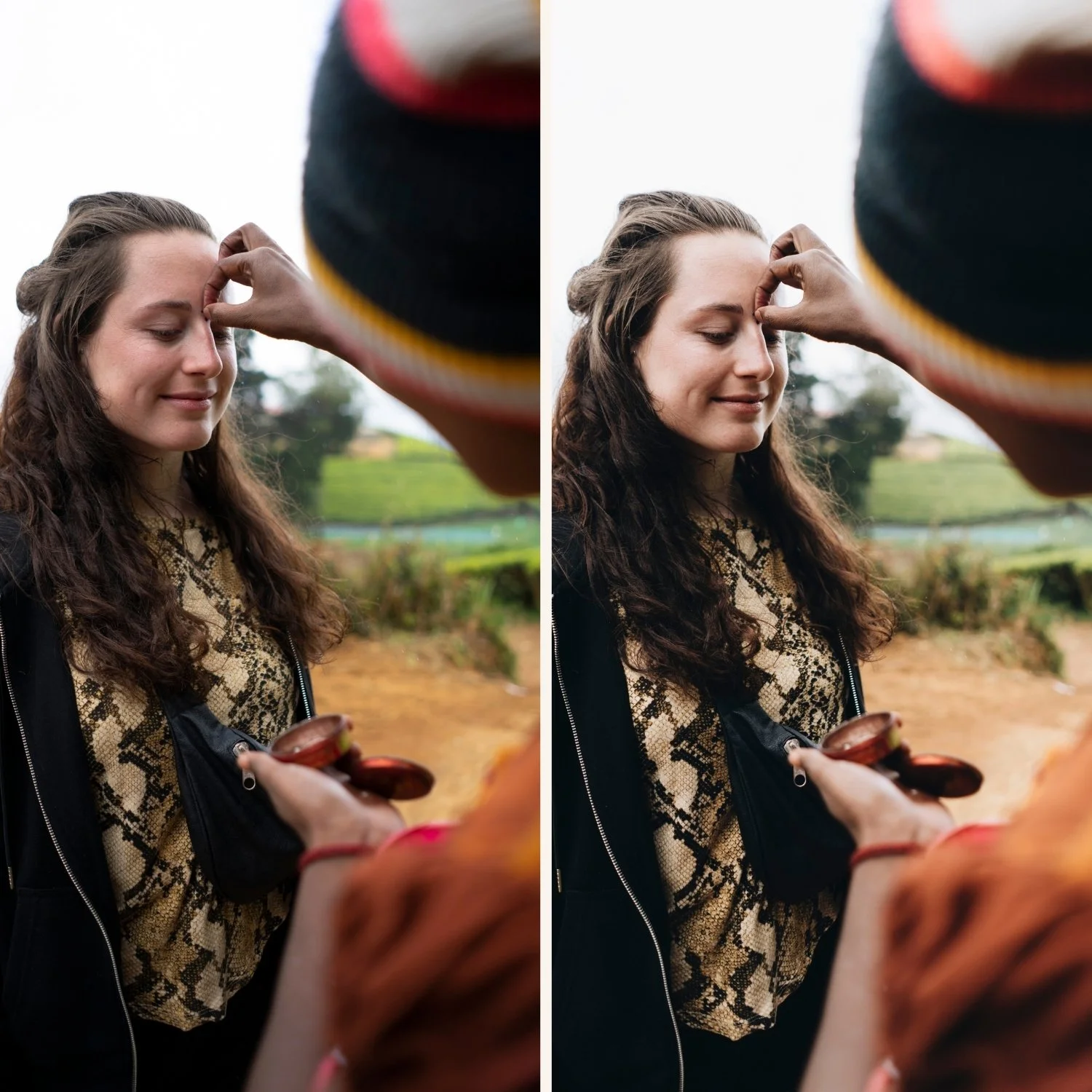
Fujifilm JPEGs have the film simulation baked in during in-camera processing. Classic Chrome applies its specific color shifts, tonal compression, and grain at the JPEG processing level.
Fujifilm RAW files contain the raw sensor data with none of that processing applied. When Lightroom opens a Fuji RAW, it uses Adobe's color rendering instead of Fujifilm's. The result looks nothing like the in-camera JPEG.
This is expected behavior. RAW files are designed to give maximum editing latitude — they intentionally bypass all in-camera processing including simulations.
The matching workflow
Step 1 — Shoot RAW+JPEG simultaneously
Enable RAW+JPEG in camera: Image Quality Setting, RAW+F (Fine JPEG).
Every shot produces two files — a RAW file for editing and a JPEG with the simulation applied for reference. Import both to Lightroom.
Step 2 — Apply the camera profile
Open the RAW file in Lightroom. Go to Camera Calibration at the bottom of the Develop module. Change the Profile to match your simulation:
Classic Chrome → Camera Classic Chrome
Provia → Camera Provia/Standard
Velvia → Camera Velvia/Vivid
Pro Neg Std → Camera Pro Neg Std
Acros → Camera Acros
The RAW immediately shifts toward the JPEG color. This is the most important single step.
Step 3 — Compare JPEG and RAW side by side
In Lightroom Classic: select both files, press N for Survey view. You can now see both simultaneously and compare.
In Lightroom Mobile: edit the RAW, then flip to the JPEG reference to compare.
Identify the specific differences — is the RAW warmer or cooler? Are shadows deeper or lighter? Is the saturation higher or lower?
Step 4 — White balance adjustment
White balance is usually the biggest visible difference after applying the camera profile. Adjust Temperature and Tint on the RAW until whites and neutral areas match the JPEG.
Classic Chrome typically needs Temperature -100 to -200 from the RAW's default. Pro Neg typically needs Temperature +50 to +150. Velvia is usually close to neutral.
Step 5 — Tonal matching
After white balance, compare the tonal structure. Common differences:
JPEG shadows are lighter than RAW: Lift Shadows +10 to +20 and Blacks +8 to +15 on the RAW.
JPEG highlights are softer than RAW: Pull Highlights -15 to -25 and apply the tone curve anchor point technique (top right anchor point down 5 units).
JPEG contrast is lower than RAW: Reduce Contrast -10 to -20.
Step 6 — Color calibration
After tonal matching, compare specific colors. Fuji simulations have characteristic color shifts:
Classic Chrome greens: Slightly desaturated and cool. Green Saturation -8 to -12, Green Hue +5 toward yellow.
Velvia oranges and reds: More saturated in JPEG. Red Saturation +5 to +8 if needed.
Pro Neg skin: Warmer and softer. Orange Saturation +5, Clarity -8.
Step 7 — Add JPEG grain to RAW
JPEG simulations include grain at higher ISOs. The RAW will be grain-free until you add it manually.
Match the grain character of your simulation:
Classic Chrome: Amount 18-22, Size 24-26, Roughness 42-48
Velvia: Amount 12-15, Size 20-24, Roughness 38-44
Acros: Amount 28-35, Size 28-34, Roughness 50-58
Step 8 — Save as a preset
Once the RAW matches the JPEG to your satisfaction, save all adjustments as a preset. Exclude Exposure and White Balance from the preset.
Next time you shoot with the same simulation in the same lighting conditions, this preset applies the complete JPEG-matching adjustment in one click.
The goal is not perfect matching
The goal is not to make your RAW look identical to the JPEG. The JPEG is the reference, not the target. If you wanted the JPEG, you would use the JPEG.
The goal is to capture the specific color character of the simulation — the Classic Chrome desaturation, the Velvia vibrancy, the Pro Neg skin quality — while retaining the RAW editing latitude for highlights, shadows, and fine-tuning.
A RAW edit that is 85% similar to the JPEG but with recovered highlights and more precise tonal control is significantly better than either the unedited JPEG or an unmatched RAW.
FAQ
Is it possible to perfectly match Fuji JPEG simulations in Lightroom RAW?
Very close but not perfectly identical. The JPEG simulation includes in-camera processing that operates at a level Lightroom cannot fully access. Camera profiles get you 80-90% of the way there. The remaining difference is usually imperceptible at normal viewing sizes.
Should I edit RAW or JPEG on Fuji cameras?
RAW for images where highlight recovery, precise color work, and maximum quality matters. JPEG for fast casual shooting where the simulation quality is sufficient. RAW+JPEG simultaneously is the best of both.
Does this workflow work in Lightroom Mobile?
Yes. Camera Calibration profiles are available in Lightroom Mobile. The full workflow applies on mobile less convenient to compare JPEG and RAW side by side but the editing steps are identical.