Beginner's Guide to Film Look Editing in Lightroom (2026)
Beginner's Guide to Film Look Editing in Lightroom (2026)
The film look in photography is not a filter. It is a set of specific editing choices that reference how analog photography actually looked lifted shadows, soft highlight roll-off, organic muted color, and warm shadow toning.
You do not need years of editing experience to achieve it. You do not need expensive software. You need to understand six adjustments and apply them consistently.
This guide covers everything a beginner needs to start editing with a film look in Lightroom.
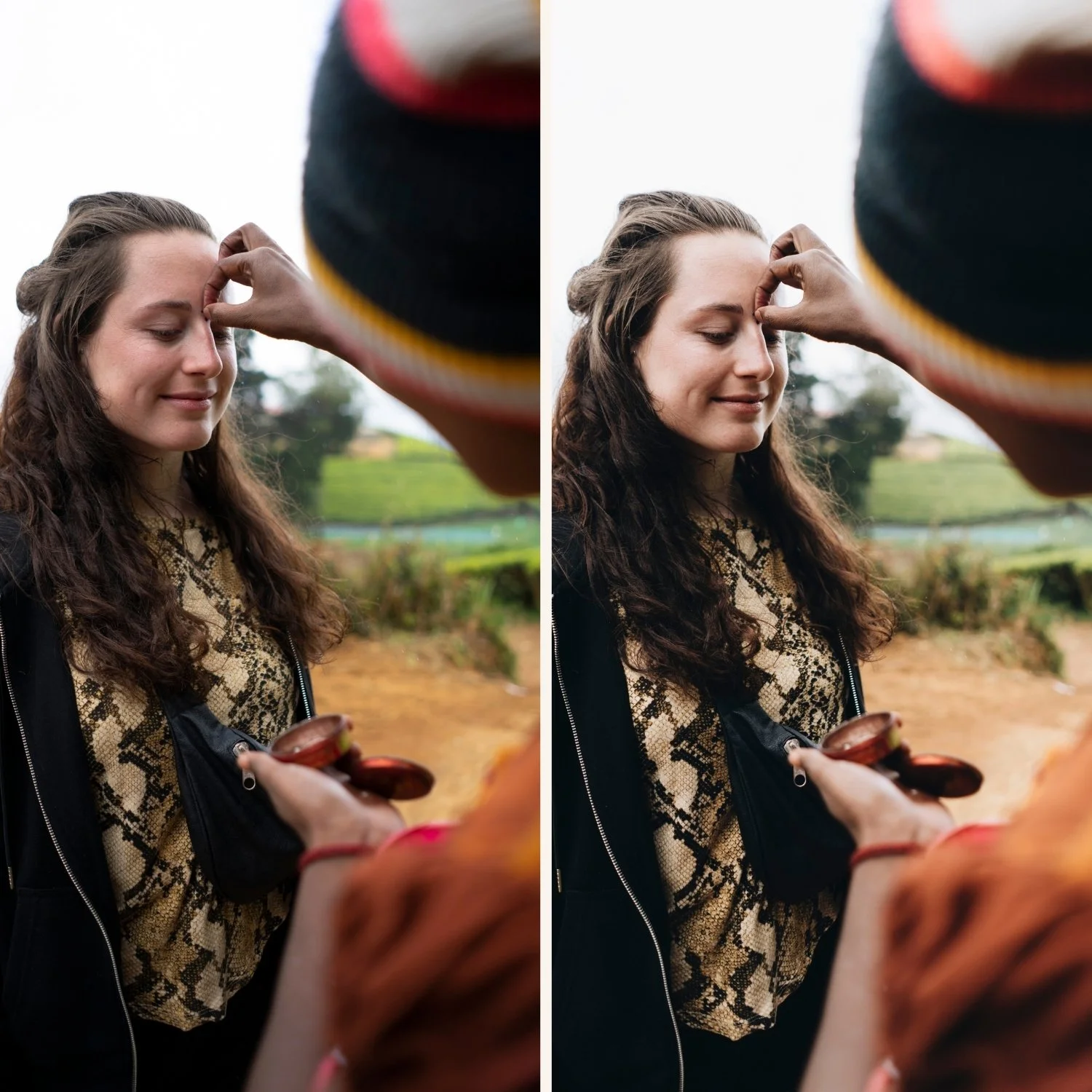
What is the film look?
Analog film photography had specific visual characteristics that came from the chemistry of film rather than intentional creative choices. These characteristics are what photographers now recreate in digital editing.
Lifted shadows. Film never produced pure black. The darkest areas always had a slightly warm, lifted quality with visible texture. In Lightroom: Blacks +20 to +30.
Soft highlights. Film highlights compressed gradually rather than clipping sharply. Bright areas stayed detailed and glowing. In Lightroom: Highlights -25 to -40.
Muted, organic color. Film color was not vivid. It was slightly muted, warm, and organic. In Lightroom: Vibrance -10 to -15, Green Saturation -15.
Warm shadows. Classic film stocks rendered shadows with a warm amber quality. In Lightroom: Color Grading, Shadows, hue 40, saturation 12.
Film grain. Fine, organic, irregular texture. In Lightroom: Grain Amount 20, Size 25, Roughness 45.
These five characteristics are what make a photo look like it was shot on film. Everything else is variation.
What you need to get started
Lightroom Mobile (free) on iPhone or Android. No subscription needed for preset use and standard editing. Download from the App Store or Google Play.
Lightroom Classic (paid) on desktop — part of Adobe Creative Cloud. For most beginners, Lightroom Mobile is sufficient to start.
A film preset. The free A6 preset applies the complete film look in one tap. Download it, install it in Lightroom Mobile, and you have the film look immediately. The manual approach takes 5-10 minutes per photo — the preset takes 30 seconds.
The beginner film look workflow
This five-step workflow applies to every photo. Practice it until it is automatic.
Step 1 — Fix exposure first
Before any color work, get the brightness right. The film look assumes a correctly exposed starting point. A dark photo with film preset applied looks like a dark digital photo with a filter. A bright photo with film preset applied looks like it could have been shot on film.
Exposure: lift until the photo looks naturally bright without clipping highlights. Highlights: -30 to -40 to protect bright areas.
Step 2 — Fix white balance
White balance affects every color adjustment that follows. A warm indoor photo plus a warm film preset creates orange results. A cool overcast photo plus a film preset looks grey and flat.
For outdoor daylight: leave white balance at Auto or 5,200-5,500K. For indoor warm light: pull Temperature left until white walls look white. For overcast: add Temperature +150 to +200 to add life to flat grey light.
Fix white balance before applying any preset.
Step 3 — Apply the preset
Tap or click your film preset. The complete film look applies — lifted shadows, muted color, warm toning, grain.
For phone photos: reduce the preset amount to 75-80% using the slider that appears after application. Phone cameras add processing that makes full-strength presets read too strong.
Step 4 — Fine-tune skin tones (portraits only)
If the photo has people: Orange Luminance +12 to +15 in Color Mix. This brightens skin naturally without adding color. It is the single most important portrait adjustment.
Step 5 — Export correctly
JPEG, 85% quality, sRGB color space, 1080 x 1350px for Instagram. Export correctly or Instagram will compress the quality.
Full export guide: Best Lightroom Export Settings for Instagram
Choosing your film direction
The film look is not one aesthetic. It is a spectrum. As a beginner, choose one direction and apply it consistently.
Clean analog: Natural, warm, versatile. Works for portrait, travel, and lifestyle in any lighting. Start with the free A6 preset.
Moody cinematic: Deeper shadows, muted color, atmospheric. Works for street photography and moody travel. Start with the free M5 preset.
Bright and airy: Luminous, soft, clean. Works for lifestyle and portrait content. Try the S2 preset from the Bright and Clean Archive.
Download A6 and M5. Apply both to twenty of your photos. One direction will feel more right. That is your direction.
Common beginner mistakes
Applying different presets to every photo. Presets work through consistency. Using a different preset on each photo creates random variation, not style. Choose one direction and apply it to everything.
Not fixing exposure before the preset. The most common mistake. Fix brightness before applying.
Using presets on phone photos at full strength. Phone cameras add processing that makes full-strength presets too strong. Always reduce to 75-80% on iPhone and Android.
Overediting after the preset. Apply the preset. Make small adjustments. Stop. The film look is about restraint — the preset does most of the work correctly.
What to learn next
Once you are comfortable with the basic workflow, these guides take your film editing further.
Understanding the manual technique: How to Make Photos Look Like Film Without Presets
The tone curve: How to Use the Tone Curve in Lightroom
Film grain: How to Add Film Grain in Lightroom
Consistent editing style: How to Build a Consistent Mobile Editing Style
FAQ
Do I need Lightroom Classic or is Lightroom Mobile enough?
Lightroom Mobile is enough to start. The free version supports preset installation and all standard editing. Lightroom Classic adds workflow tools for large volumes of photos but is not necessary for beginner film editing.
How long does it take to learn the film look?
The basic workflow takes one session to learn. Consistent results take two to three weeks of practice. A recognizable personal style takes two to three months of consistent application.
Full guide: How Long Does It Take to Learn Lightroom?
Do film presets work on all cameras?
Yes. The same preset works on Canon, Sony, Fuji, Nikon, iPhone, and Android. Different cameras need small preparation adjustments but the preset itself is universal.
Is the film look possible on phone photos?
Yes. Reduce Sharpening to 20 and Clarity to -10 before applying the preset. Reduce preset amount to 75-80%.
Full guide:Lightroom Mobile Film Editing Guide